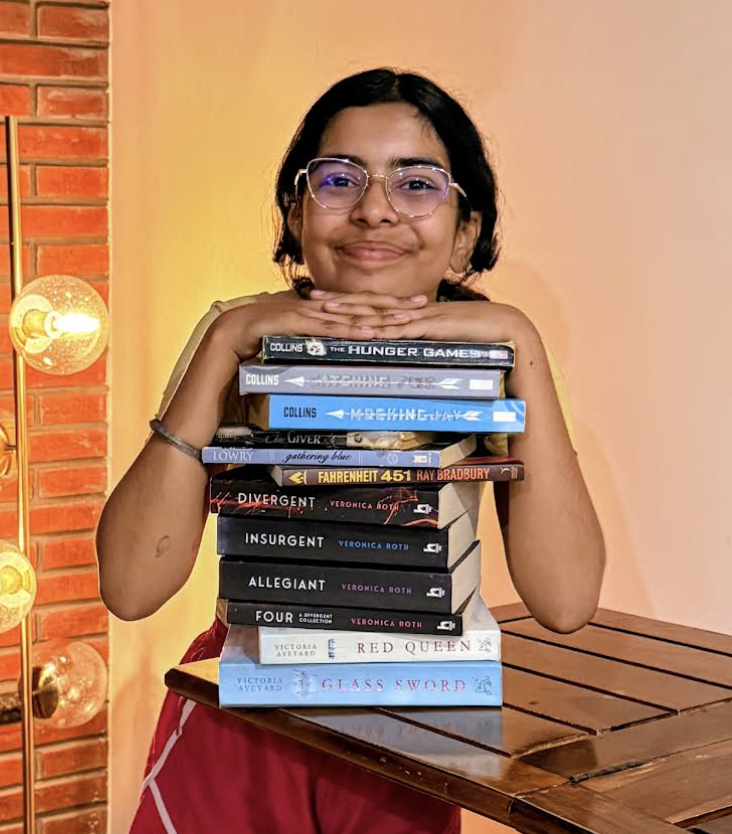
I would like to start by saying I am not writing a book review. I am not converting the Spaghetti Principle into a review site. That’s barely my style.
But when your favourite teacher asks you to promote your favourite genre of books, you hop to it. Even if you’re two weeks late and have been victim to the feedback loop they call procrastination.
Sorry, Miss Mobika.
So I write this blog to propagate dystopia. For the ones who haven’t yet been unhealthily addicted to this type of book, I am equal parts pitiful and jealous — you do get the joy of reading one for the first time, after all!
What is dystopia, exactly? Dystopia is a form of literature that forces readers to consider a future where things go south. It follows protagonists who, usually, love their world and a lot about it, or are secretly loathe of it but unable to act.
Yes, Jonas. What a wonderful world it is where you can’t speak imprecisely, learn history, or be even a bit better than anyone else. How awesome that your life lies in the hands of wrinkly ‘Elders’ who know you better than you do. Absolutely darn-tootin’ wonderful.
They find something about them special, supernatural, or frowned upon in their world, and get thrust into the world of revolution.
What happens then never fails to fascinate me, because dystopia’s flexibility is such that there are infinite possible conclusions to the story. The main character can win, lose, defect, die, have a bittersweet ending or an ambiguous one.
But enough of the book review.
Dystopia is so scary, and frankly, easily banned, because in its own subtle way it criticizes society for what it has become and cautions what will be. I often wonder if Governments see the genre on a book and then their ‘CENSORED CONTENT’ stamp is let loose.
Margaret Atwood’s The Handmaid’s Tale? Banned in parts of the U.S.
George Orwell’s Animal Farm? 금지된 in North Korea.
George Orwell’s 1984? 被封禁 in China.
Aldous Huxley’s Brave New World? Toirmiscthe in Ireland.
Ray Bradbury’s Fahrenheit 451? Banned in parts of the U.S. Again. Just like all of the above mentioned books.
Because that’s what scares governments. Books that challenge their power. And unfortunately for my favourite type of literature, that’s exactly what dystopia is.
But the saddest part isn’t that books that raise their voices (or fonts, because I don’t think books can speak) are immediately shut down in various parts of the world. The saddest part is that dystopian literature is dying, and I as an individual can only buy so many books and write so many blogs to stop this.
In the late 2000s and early to mid 2010s, the featured genre of this blog saw a huge rise, with popular series like The Hunger Games, Red Queen, The Selection, Lunar Chronicles, and Divergent blowing up. All the cool kids read dystopia.
But with the digital and AI revolutions of the 2020s, cliches took a rise and dystopia saw its downfall. It was death by trope and plagiarism. A terrible way to smother the sparks of human awareness.
We’ve now reached an era where I mention any of the above names and the youngest generation will respond with a blank stare and a tilt of head. This is what the world has come to.
To quote the aforementioned generation, we’re cooked.
But that’s why I write today. To ask you, dear reader, to help bring this amazing form of writing back into the spotlight where it belongs. To request you to search it up on Google and give it a shot. To beseech you to open a book like this and let it carry you away.
Because you’d be surprised what 200 pages of paper stitched together can do to you.
It could open your eyes to today’s problems, to society’s underlying undoings, to the status quo’s very prominent yet well-masked flaws.
It could be the kindling spark in a raging fire of righteousness.
It could be key to changing the world for the better. And isn’t that what we all want to do?
So do me a favour.
Pick a good dystopian novel.
Open it.
And see where it takes you.


Leave a Reply